Mustang Prairie Halloween costume fundraising drive
It Must Be Love: A Mustang Prairie RomanceMustang Prairie Halloween costume fundraising drive is a community project that turns charitable money into shared creative labor. Proposed by Eric and developed with Trixie’s practical leadership, it seeks to ensure that children who might otherwise receive no costume can still have the imaginative accessories and handmade pieces that make Halloween meaningful. Its decisive significance lies in the way it joins social provision to belonging: the town does not merely distribute finished goods, but gathers to make possibility together.
Causes and Background
The drive begins with Eric’s rejection of a limited purchasing model. Rather than spend the budget on a fixed number of ready-made costumes and leave some children without one, he proposes buying large quantities of fabric and accessories so residents can produce costume components themselves. The plan is deliberately expansive: children can receive wings and wands, capes and tiaras, and the many other pieces that complete costumes for trick-or-treaters of different ages. Charity therefore becomes less a transaction than a system for multiplying participation.
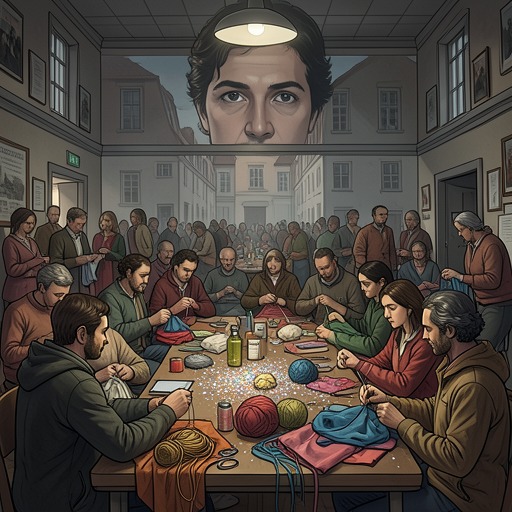
Trixie enters the project through her knitting and sewing classes. By the time of the Saturday session, online registration has reached its limit, forcing the classes into a larger room with better lighting, more comfortable chairs, and long tables covered with yarn scraps in every imaginable weight, thickness, and color. She dismisses another full class by thanking participants for knitting with her and looking ahead to the sewing machines Eric has promised. The crowded enrollment demonstrates that the town possesses not only a need for costumes but also an appetite for shared instruction and useful work.
The project also gives Trixie a new civic identity. Eric tells her that mothers throughout the week have praised the classes and are eager to help make the costumes. He does not treat her as a temporary volunteer whose contribution must be supervised; he tells her that he trusts her and hopes to involve her in more community-building work. His confidence matters because Trixie has recently been trying to establish stability after her life with Preston, and because her own clothing-line ambitions have remained stalled despite months of sketches, possible names, logo ideas, and contact with a graphic designer. The costume drive offers an immediate arena in which her skills can produce visible results.
Organization and Participants
Eric supplies administrative support and resources. When Trixie arrives early for a planning conversation, he gives her a Mustang Prairie flag card for credit-card or petty-cash purchases and asks her to find ways for people to do what she does. His request is broader than shopping: he wants classes that bring young and old members of the community together and give them something constructive to do. Shellie is credited with obtaining the sewing tables, a gesture that reveals the project’s distributed leadership. Eric’s satisfaction comes not from claiming the achievement but from recognizing what a capable leader can inspire others to do.
Trixie’s role encompasses teaching, procurement, design judgment, and logistical coordination. Even while recovering from a painful foot injury and working behind the counter of Under the Skirt, she imagines how the drive can continue and recognizes that a part-time worker would help her sustain her store and developing line. During the shopping, she takes responsibility for identifying the materials while Jack manages the cart and tablet. She explains why the list includes multiple kinds of wands for princesses, princes, magicians, and sorcerers, turning apparently small purchases into a considered response to the range of costumes children may want to become.
The social network around the drive is unusually broad. Parents attend with their children, local residents fill the classes, and the town’s existing friendships supply food, labor, equipment, and encouragement. Jack’s daughters greet Sadie as Aunt Sadie when Jack brings cookies, sausages, macaroni salad, and beer to a community gathering, illustrating the informal kinship through which Mustang Prairie’s projects operate. The same network later supports the wider costume-making day, where the drive’s charitable purpose is carried by relationships that already cross household and family boundaries.
What Happens
By the main workday, Eric has reserved two large rooms for the drive. Trixie sets up eight sewing tables, which will later be shared with the high school’s drama department, a semicircle of chairs for knitting and hand sewing, and a back area of long tables known as the Glitter Station beside the snacks. The arrangement divides the work without dividing the community: sewing, handcraft, decoration, eating, and conversation all occupy the same event space.
The day is designed for broad attendance. Trixie expects half the town to pass through, helping make sure that the less fortunate children of Mustang Prairie can have a good Halloween. Free food and a party are practical attractions, and scheduling the event early allows seniors to attend as well. The drive thus accommodates people with different ages, abilities, and reasons for coming. Some participants contribute skilled needlework; others provide enthusiasm, supplies, decoration, or simply the presence that makes the undertaking communal rather than institutional.
The event’s labor is also set against Trixie’s exhaustion. She has spent the week working unusually hard at her store and at her new business, and she arrives after a gathering where she drank too much wine with very little energy left. Yet she has already arranged the rooms and the tools before the morning is far advanced. The contrast between fatigue and continued responsibility makes the drive a concrete test of her developing professionalism: community care depends on preparation, repetition, and unglamorous physical work, not only on the excitement of an idea.
Consequences and Aftermath
The immediate consequence is a successful public collaboration in which funds become materials, materials become costumes, and individual skills become a shared resource. Eric’s earlier report that mothers enjoy the classes and want to participate confirms that the drive has already extended beyond the classroom. Trixie’s instruction is not an isolated service; it creates the skill base through which the larger campaign can function.
The drive also strengthens Trixie’s relationship with the Thorpe family. Jack’s daughters accept her with an ease they have not shown toward women other than their mother since Marissa’s death, and their warmth makes her increasingly present within the family’s social world. Jack notices both their happiness and his own attraction to Trixie. The costume project therefore operates on two levels: it distributes practical care to children across Mustang Prairie while quietly drawing Trixie into a household still organized around grief, parenting, and the search for a new family balance.
Its influence continues into the town’s later public rituals. At the All Hallow’s Get Down, Jack and Trixie dance publicly while Thriller begins, and he pulls her toward the center of the floor because he wants everyone to see that she is with him. The Halloween season thus moves from making costumes for children to staging adult identities and relationships before the community. Trixie’s work with fabric and performance has helped establish the visual and social vocabulary through which Mustang Prairie celebrates itself.
Narrative Significance
The costume drive is a threshold event in Trixie’s movement from private survival toward public authorship. She is simultaneously building a lingerie business, learning to manage inventory and workspace, and discovering that her needle skills can organize other people. The drive offers a less risky but equally important version of entrepreneurship: opportunity recognition, resource mobilization, quality of labor, teaching, and community trust all appear before her fashion line is fully launched.
It also supplies a counterpoint to the instability of Trixie’s earlier family life and marriage. Her parents provided for her but moved from hobby to hobby, interest to interest, religion to religion, and place to place; Trixie now seeks stability through work that is planned, material, and accountable. In the costume drive, stability is not isolation. It is produced through tables, machines, fabric, classes, food, and people who return to help one another.
Finally, the drive makes Mustang Prairie’s peace tangible. Its achievement is measured not only by the number of costumes produced but by the transformation of strangers and acquaintances into collaborators. The campaign’s central gesture is simple but consequential: a child’s costume is treated as something the community can make together. That gesture anticipates the later success of Sexy Separates by Trixie, whose runway launch likewise depends on friends, models, music, photographs, and shared labor. Across both projects, Trixie’s creative work becomes a means of distributing confidence, visibility, and belonging.